
Chanukah Blessings in Hebrew, Transliteration, and English (Plus Haneirot Halalu and Maoz Tzur)
The three Chanukah candle blessings in Hebrew, transliteration, and English, with audio for every line and a free printable card. First candle: Dec 4, 2026.
Every night of Chanukah you say two short blessings before lighting the menorah, and on the first night you add a third. This page has all three in Hebrew, transliteration, and English, one line at a time, with a recording of each line so you can hear how it sounds. Keep it open on your phone next to the menorah, or print the one-page card. After the blessings come Haneirot Halalu, a short paragraph, and Maoz Tzur, the song many families sing.
The last candles are lit on Friday, December 11. For the full how-to (where the menorah goes, which candles to buy, the two Friday nights and the Saturday night), see our guide to lighting the menorah for Chanukah 2026. Quick disclosure: Bayit is our app, and this is its journal. We mention it once near the end.
The order, in one minute
- Set up the candles for tonight, from right to left.
- Light the shamash (the helper candle) and hold it.
- Say the blessings: two every night, three on the first night.
- Light the newest candle first, the one farthest left, then move right.
- Say Haneirot Halalu, then sing Maoz Tzur if your family does.
The blessings come before the lighting. That is the general rule for blessings over a mitzvah: you say the blessing, then you do the thing.
Each line below has a play button. The recordings are slow on purpose, one phrase at a time, so you can say each phrase after you hear it. Play the whole blessing reads it start to finish and lights each line as it goes. They use the modern Hebrew pronunciation the transliteration follows. Many Ashkenazi families say the same words with older vowels, Boruch atoh Adonoy. Both are right, so use the one you grew up hearing.
Blessing 1: on lighting the Chanukah light
Said every night, all eight nights.
Some siddurim say ner shel Chanukah (נֵר שֶׁל חֲנֻכָּה) instead of ner Chanukah. Both are real traditions. Use whatever your siddur or family uses and don't worry about it.
Blessing 2: for the miracles
Also said every night.
Bazman hazeh means "at this season." The miracle happened in the days of the Maccabees, in the second century BCE, and we thank God for it at the same point in the year. The same blessing is said over the Megillah on Purim.
Blessing 3: Shehecheyanu, first night only
Said on the first night of Chanukah. If you miss the first night, say it the first time you light that year.
Shehecheyanu is the blessing for new and once-a-year things: the first night of a holiday, a new fruit of the season, new clothes. In 2026 the first night is a Friday, so you say all three blessings in the late afternoon, light the menorah, and then light the Shabbat candles.
The Hebrew on this page follows the Ashkenazi siddur as Sefaria prints it. Sephardi siddurim have the same three blessings, word for word.
How to light, night by night
You add one candle each night, so night one has a single candle and night eight has all eight, with the shamash lit every night. Put tonight's candles in from the right. The newest candle is the one farthest left, and it is the one you light first. Here is Chanukah 2026:
When to light. Many families light at sunset or when it gets dark. If you get home later, you can still light in the evening, ideally while others at home are awake to see it. The candles should burn for at least half an hour after dark, which the small candles in most boxes manage on a weeknight.
The two Fridays, December 4 and 11. Once Shabbat starts you can't light a fire, so the menorah comes first, just before the Shabbat candles. Use candles or oil that will last until half an hour after dark, which on a Friday can be more than an hour. Check the time where you live on our Shabbat candle-lighting times page.
Saturday night, December 5. Wait until Shabbat is over. Many families make Havdalah first and then light the menorah. Customs differ, so go with your family or your rabbi.
Who says the blessings
Whoever lights says them. Women are obligated in Chanukah lights just like men; the Talmud (Shabbat 23a) explains that they were part of the miracle too. Customs differ on how many menorahs a home has:
- Many Ashkenazi families have each person light their own menorah, often kids included, and each one says the blessings.
- Many Sephardi families light one menorah for the whole household. One person lights and says the blessings, and everyone else listens and answers amen.
If you are a guest at someone else's home, or you live in a dorm, the rules get specific. That is a good question for a local rabbi.
What if you forget the blessings? Many authorities say that if you remember while you are still lighting, you can say them then. If you already finished, ask your rabbi what to do. On the following nights, just say them as usual.
Haneirot Halalu: "These lights"
This short paragraph is said right after the first candle is lit, or once all the candles are lit, depending on your custom. It comes from Masechet Soferim (20:6), an early collection of synagogue laws. It is not a blessing, so if you trip over a word, nothing is lost.
Siddurim differ by a word here and there. This is the Ashkenazi text. Some siddurim say anu madlikin, and Sephardi ones say anachnu madlikin and list the miracles in a slightly different order. The middle of the paragraph is the practical part. The candles are for looking at, not for reading by, which is why the shamash sits apart from the others.
Maoz Tzur: "Mighty Rock"
Maoz Tzur is the song most Ashkenazi families sing after lighting. It was written in medieval Europe by a poet named Mordechai. We know that because the first letters of the first five stanzas spell his name in Hebrew, מ־ר־ד־כ־י. Each stanza covers a different time the Jewish people were saved: Egypt, Babylon, the Purim story, and then the Greeks and the Chanukah oil. Most people sing just the first stanza:
The English song "Rock of Ages" that some synagogues sing uses the same tune, but it is a loose 19th-century adaptation, not a translation. Many Sephardi families sing other songs instead and say Psalm 30, Mizmor shir chanukat habayit, "a song for the dedication of the House."
Print the blessings card
The three blessings fit on one page, with the candles for each night along the bottom and a code that opens this page, so anyone can hear the lines read aloud. It is free to print, copy, and hand out. Shuls, Hebrew schools, and families hosting a Chanukah party are welcome to print a stack or link to it.
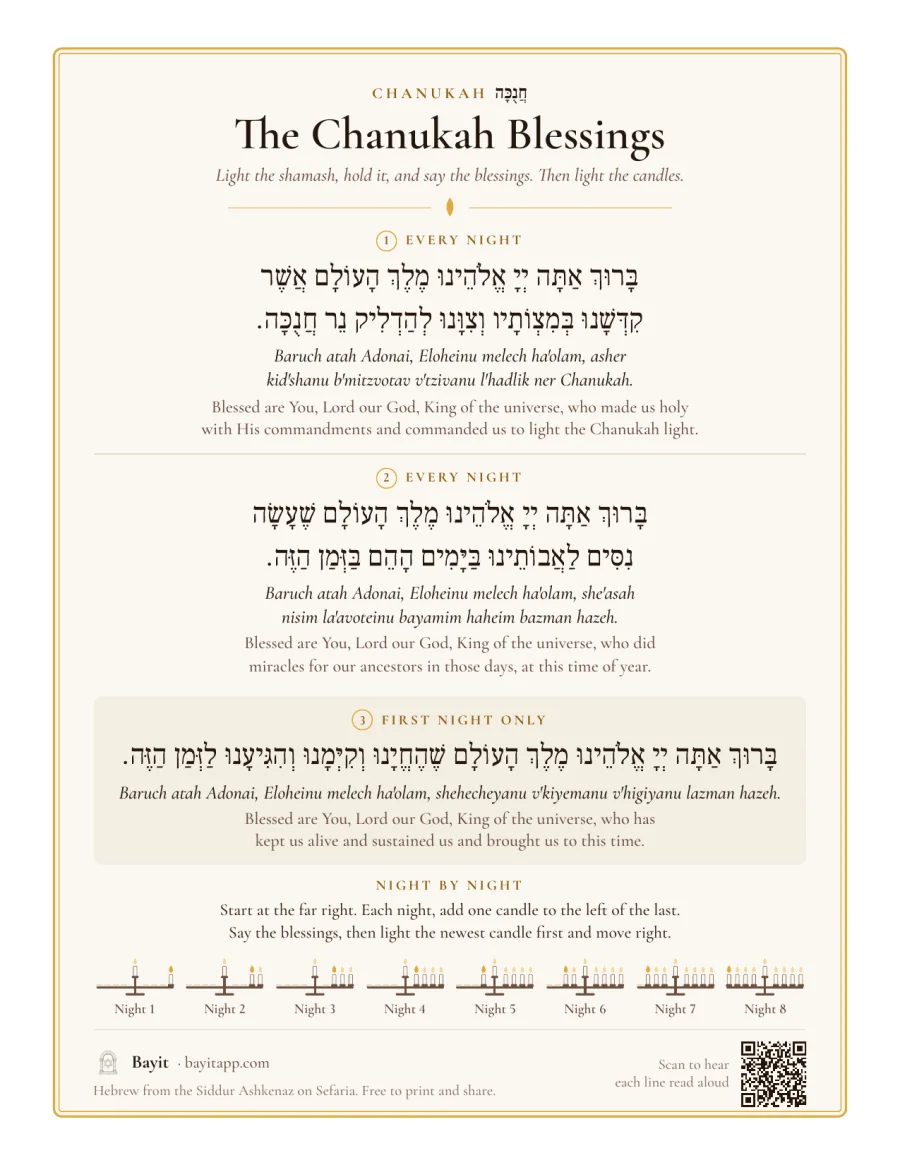
Learn the blessings in eight nights
Eight nights in a row is a ready-made habit. You will say the same two blessings eight times, which is enough to know them by heart if you take it one piece at a time:
- Nights 1 and 2: play each line, then say it after the recording. Just get the flow.
- Nights 3 and 4: say the opening, Baruch atah Adonai, Eloheinu melech ha'olam, without looking. It is the start of almost every Jewish blessing, so you will use it all year.
- Nights 5 and 6: add the ending of the first blessing, l'hadlik ner Chanukah.
- Nights 7 and 8: try the second blessing from memory and keep the page as a backup.
If you are still sounding out Hebrew letters, read the transliteration and glance at the Hebrew as you go. Our Hebrew alphabet chart and guide to reading Hebrew as an adult are good next steps. Saying the blessings in English is fine too, if that is where you are right now.
The opening formula is worth knowing because it carries over. The same words start the Hamapil blessing in the bedtime Shema, the blessings over Shabbat candles in Shabbos, and Havdalah. Chanukah also adds Al HaNissim to the Amidah and Hallel in the morning. For the dates of everything else this year, see our Jewish holidays 2026 and 2027 calendar.
Bayit, our daily practice app, is built around this same idea of small daily pieces. The Daily Plan gives you one short bit of Torah and tefilah for today, with the Jewish calendar built in, so Chanukah shows up on its own when it gets close.
Want to keep a small daily habit going after the eighth candle? Try the Bayit Daily Plan.
Frequently asked
What are the blessings for lighting Chanukah candles?
Every night you say two blessings before lighting: 'Baruch atah Adonai, Eloheinu melech ha'olam, asher kid'shanu b'mitzvotav v'tzivanu l'hadlik ner Chanukah' (for the commandment to light) and 'Baruch atah Adonai, Eloheinu melech ha'olam, she'asah nisim la'avoteinu bayamim haheim bazman hazeh' (for the miracles). On the first night you add Shehecheyanu.
Do you say the Chanukah blessings before or after lighting?
Before. Light the shamash, hold it, say the blessings, and then light the candles, starting with the newest one on the left. Haneirot Halalu and Maoz Tzur come after the lighting.
Which night do you say Shehecheyanu on Chanukah?
On the first night. In 2026 that is Friday, December 4, before Shabbat. If you miss the first night, say Shehecheyanu the first time you light that Chanukah.
Is it 'ner Chanukah' or 'ner shel Chanukah'?
Both are used. Some siddurim end the first blessing with 'l'hadlik ner Chanukah' and others with 'l'hadlik ner shel Chanukah.' Follow your siddur or family custom.
What is Haneirot Halalu?
A short paragraph said after lighting the Chanukah candles. It explains that the lights remember the miracles God did for our ancestors and that they are holy, so we only look at them and don't use their light for anything else. It comes from Masechet Soferim 20:6.
Who wrote Maoz Tzur?
A medieval poet named Mordechai. The first letters of the first five stanzas spell his name in Hebrew. The song covers the Jewish people being saved from Egypt, Babylon, Haman, and the Greeks, and most families sing only the first stanza after lighting.
Can you say the Chanukah blessings in English?
Yes. A blessing said in a language you understand counts. Many beginners start with English or transliteration and pick up the Hebrew over the eight nights.
How do you pronounce the Chanukah blessings?
Slowly, a phrase at a time: Baruch atah Adonai (ba-ROOKH a-TAH a-do-NAI), Eloheinu melech ha'olam (e-lo-HAY-nu MEH-lekh ha-o-LAHM), then the ending for that blessing. The ch in Baruch, melech and Chanukah is the throaty sound in the composer's name Bach, not the ch in church. This page has a recording of every line to say along with.
Is there a printable copy of the Chanukah blessings?
Yes. Bayit's free one-page card has the three blessings in Hebrew, transliteration, and English, with the candles for each of the eight nights. It is US Letter size, prints on A4, and shuls and Hebrew schools are welcome to copy it.